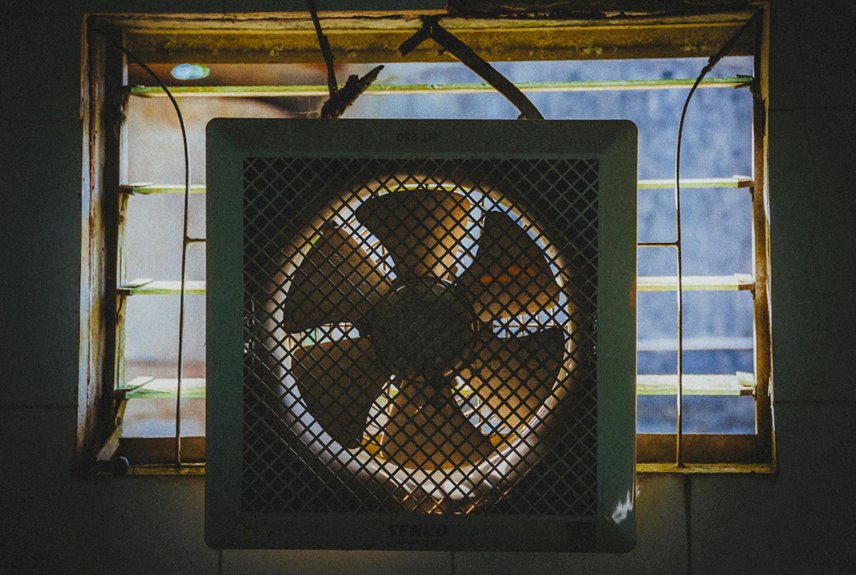
Your bathroom needs an exhaust fan. Here’s why it matters: showers create moisture that damages walls, promotes mold, and leaves mirrors foggy. A window alone won’t cut it—building codes require 50 CFM of ventilation for good reason. Without proper airflow, you’re inviting wood rot and structural problems into your home. Think of it as your bathroom’s protection against hidden damage. Want to know how to pick the right fan and install it properly?
What Does a Bathroom Exhaust Fan Actually Do?
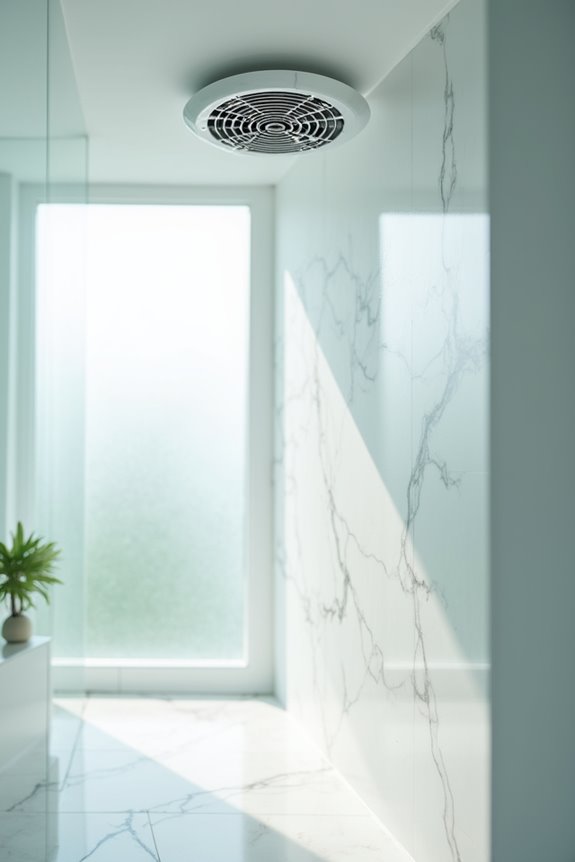
Ever wonder why your bathroom mirror turns into a foggy mess after a hot shower? That’s where an exhaust fan comes in. It’s basically a mechanical system that sucks humid air right out of your bathroom and vents it outside your house. Pretty straightforward, right?
Here’s what’s happening: when you shower, moisture fills the air. Without an exhaust fan, that dampness sticks around—settling on your walls, mirrors, and ceiling. An active exhaust fan pulls that moist air out before it causes problems. By removing humidity, you’re preventing condensation buildup and creating an environment where mold and mildew can’t thrive.
Think of it as your bathroom’s personal bodyguard, constantly fighting moisture damage.
Signs Your Bathroom Needs Better Ventilation

If you’re noticing foggy mirrors that won’t clear, dark spots creeping across your ceiling, or that lingering musty smell after your shower, your bathroom’s probably telling you it needs help. You might also spot peeling paint around the shower or feel like your walls stay damp way too long—these aren’t just annoying cosmetic problems, they’re signs that moisture is building up faster than your current ventilation can handle. The good news is recognizing these warning signs means you can tackle the problem before it turns into expensive structural damage or a full-blown mold situation.
Excessive Moisture And Humidity
Have you noticed your bathroom mirror stays fogged up long after your shower ends? That’s your first clue that moisture is hanging around where it shouldn’t be. When humidity builds up, it doesn’t just fog mirrors—it creeps into your walls and ceiling too. I’ve seen peeling paint and warped drywall in bathrooms lacking proper ventilation. Mold and mildew love these damp conditions, showing up as dark spots on grout and corners. That musty smell? That’s moisture that won’t leave. Here’s what gets me: excess humidity actually costs you money. It weakens your home’s insulation and forces your heating and cooling systems to work harder. Installing bathroom exhaust fans directly addresses this problem by removing moisture before it damages anything. They’re your best defense.
Mold, Mildew, And Odors
The moisture problem doesn’t stop at warped walls—it creates the perfect breeding ground for something far worse. That excess humidity? It’s basically rolling out a welcome mat for mold and mildew. Here’s what you’re likely dealing with:
- Mold growth on walls, ceilings, and grout that spreads faster than you’d expect
- Foggy mirrors that won’t clear even after you’ve finished your shower
- Persistent musty odors that linger no matter how much you clean
- Black or green spots appearing in corners and around fixtures
Nobody wants to discover these unwelcome guests in their bathroom. These warning signs tell you exactly what’s happening. Your bathroom needs better air circulation. An exhaust fan is your defense against mold taking over. This is a common issue, and many people face it.
Structural Damage And Deterioration
Beyond the cosmetic annoyances of mold and musty smells, what happens when moisture keeps accumulating behind your bathroom walls? I’ll tell you—it gets serious. Hidden moisture seeps into the wooden framing and joists supporting your bathroom, gradually weakening them. Over time, this sustained dampness causes wood rot, which compromises your home’s structural integrity. You might notice warped cabinetry, peeling paint, or soft spots in flooring—all red flags that moisture damage is progressing. The insulation in your attic loses its effectiveness too, forcing your heating and cooling systems to work harder. Mold growth accelerates in these damp spaces, creating health concerns alongside structural issues. An exhaust fan prevents this domino effect by removing moisture before it causes lasting damage. Your home needs this protection.
Can a Window Replace a Bathroom Fan?

When moisture builds up after a hot shower, cracking open a window seems like an obvious solution—and honestly, it’s better than nothing. But here’s the reality: windows can’t match what a dedicated exhaust fan delivers for bathroom ventilation.
Why windows fall short:
- They rely on weather and wind patterns you can’t control
- They don’t meet modern building codes requiring 50 CFM intermittent ventilation
- They introduce outdoor contaminants, drafts, and temperature swings
- They leave lingering humidity that causes foggy mirrors and potential mold
A window might help temporarily, but it won’t prevent moisture from settling into walls and ceilings. You’d need to keep it open constantly—impractical and uncomfortable. If you want to protect your bathroom, pairing a window with an exhaust fan gives you the best protection.
Building Code Requirements for Bathroom Ventilation

Your local building code probably requires some form of bathroom ventilation, whether that’s a fan rated for 50 CFM (cubic feet per minute) running intermittently or a continuous 20 CFM system—the exact number depends on where you live. You’ll face choices between natural ventilation through windows and mechanical fans, though codes almost universally favor fans because they work reliably when it’s freezing outside and opening windows isn’t practical. When inspectors arrive, they verify that your system vents directly outdoors (not into your attic), meets those CFM standards, and carries proper certification labels. Skipping the fan or venting it incorrectly will result in failing inspection and requiring you to redo the installation.
Code-Mandated Ventilation Standards
Why does your bathroom need rules about air? Because moisture loves hiding in walls, and building codes exist to protect your home. I’ve learned that most jurisdictions require specific bathroom ventilation standards to keep your spaces healthy.
Here’s what you should know:
- Minimum ventilation rates typically demand 50 CFM intermittent or 20 CFM continuous
- Air must vent outdoors, never into attics or interior spaces where moisture damages structure
- Larger bathrooms need increased CFM or multiple fans for proper air changes per hour
- Modern airtight homes almost always require mechanical ventilation for adequate moisture control
These aren’t suggestions—they’re requirements designed to prevent costly damage. Modern bathrooms especially can’t rely on natural ventilation alone. Your local building codes spell out exact bathroom ventilation standards for your area, so checking with them or an HVAC contractor keeps you compliant.
Natural Versus Mechanical Options
So you’ve got a window in your bathroom—does that solve your moisture problem? Not really. Sure, windows help, but they’re unreliable. You can’t control them, and they won’t work when it’s cold outside or raining. That’s where an exhaust fan comes in.
Think of an exhaust fan as your bathroom’s bodyguard against moisture. It actively pulls humid air out of your space and sends it outside—no guessing involved. Building codes recognize this difference. While windows might technically meet minimum standards in some places, an exhaust fan does the heavy lifting, especially in modern, tightly sealed homes where air doesn’t naturally escape.
An exhaust fan gives you consistent, powerful moisture removal. That means less mold, less mildew, and a healthier bathroom overall.
Compliance And Inspection Requirements
Now that you understand why an exhaust fan beats a window, you need to know what your local building codes actually demand.
Building codes require ventilation code compliance for bathrooms. Here’s what you’ll likely encounter:
- Minimum CFM rates – Small bathrooms (50 sq ft or less) need at least 50 CFM intermittent ventilation; larger ones demand higher rates.
- Outdoor venting only – Your duct must exit outside, never into your attic, where moisture causes mold problems.
- Continuous or intermittent options – Codes specify which based on your bathroom size and how often it’s used.
- Professional verification – You’ll need HVI certification or third-party proof that your fan actually performs as rated.
Most jurisdictions require inspections before final approval. Check your local codes early—compliance prevents problems later.
How to Size Your Exhaust Fan: The CFM Formula

What makes one exhaust fan work beautifully in a bathroom while another leaves you standing in a steam cloud wondering if anything’s actually happening? The answer lies in CFM—cubic feet per minute—the measurement that tells you how much air your fan moves.
I’ll break down the sizing formula for you. Start with your bathroom’s square footage. You’ll want roughly 1 CFM per square foot as your baseline. For a 7-by-10 bathroom, that’s 70 CFM. But here’s where it gets interesting:
| Bathroom Size | Recommended CFM | Installation Notes |
|---|---|---|
| Up to 50 sq ft | 50 CFM | Minimum standard |
| 50-100 sq ft | 1 CFM per sq ft | Standard sizing |
| 100+ sq ft | Additional capacity | Consider ceiling height |
| Tall ceilings (9+ ft) | Add 20% extra | Increased volume |
| High-humidity areas | Boost 25% | Extra moisture control |
Don’t guess. Look for HVI-certified fans confirming actual performance.
CFM Ratings Explained: What Numbers Mean for Your Bathroom
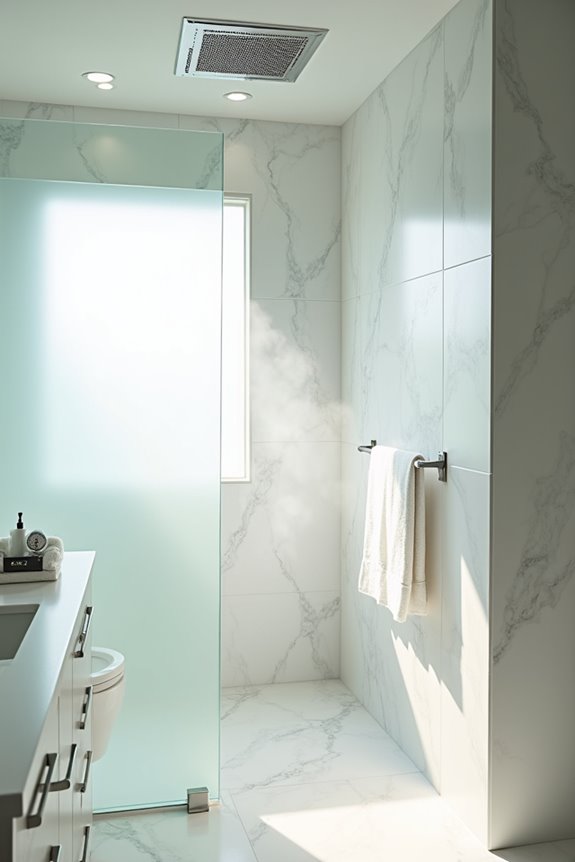
Once you know your bathroom’s square footage, those CFM numbers start making actual sense. I’ll break down what these ratings actually mean for your space.
- Small bathrooms need 50 CFM – Think of a compact powder room where you’re just running in and out.
- Medium bathrooms need 70 CFM – A standard 7×10 ft bathroom falls here, which is where most of us live.
- Larger bathrooms need more CFM – Your master bath with that fancy soaking tub? You’re looking at higher numbers to handle moisture.
- HVI certification matters – This badge guarantees the fan actually delivers what the label promises, not just marketing fluff.
Higher CFM isn’t overkill. It means your fan works smarter, eliminating humidity faster and keeping mold at bay.
Where Should Your Exhaust Fan Vent?
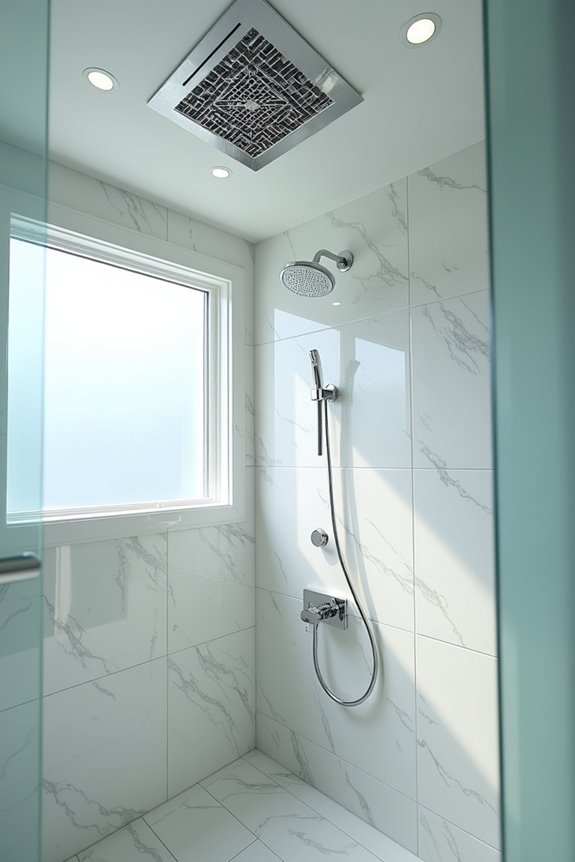
Modern, airtight homes depend on getting that damp air out completely. When you vent correctly, you’re protecting your home’s structural integrity and improving indoor air quality. That’s what matters.
Why Venting to Your Attic Is a Mistake

How tempting it must be to take the easy route—just route that exhaust duct into your attic and call it done. I get it. But here’s why that shortcut backfires:
- Moisture gets trapped – Your bathroom’s excess humidity doesn’t escape outdoors; it lingers in your attic instead.
- Mold takes hold – Damp insulation, wood sheathing, and framing become breeding grounds for mold growth.
- Insulation weakens – Wet insulation loses its ability to keep your home comfortable and energy-efficient.
- Wood rots away – Moisture slowly damages the structural framing that holds your house together.
We’re all trying to save time and money, right? But venting to your attic costs you later in repairs. Exterior venting—through your roof, walls, or eaves—properly sends that humid air outside where it belongs. Your future self will thank you.
Intermittent vs. Continuous Ventilation: Which Does Your Home Need?

When you’re deciding between an intermittent fan that kicks in at 50 CFM during showers versus a continuous one running quietly at 20 CFM all day, you’re really asking three connected questions: What does your building code actually require, how well can each approach actually stop mold and humidity, and how tight is your home anyway? Your bathroom’s size matters here—a tiny half-bath might pass inspection with just intermittent ventilation, but if you’ve got a modern, super-sealed home that traps moisture like a greenhouse, continuous ventilation could be the difference between dry walls and a mold problem. Let’s look at each of these factors so you can figure out which one works best for your specific situation.
Building Codes and Requirements
Building codes have specific answers. They require explicit ventilation rates to keep moisture and mold at bay. Here’s what you’re looking at:
- Intermittent fans need around 50 CFM during showers to rapidly remove moisture
- Continuous fans operate at roughly 20 CFM to maintain baseline humidity control
- Modern, airtight homes typically benefit from continuous ventilation for consistent air quality
- Older homes can often rely on intermittent operation with window use as backup
Your specific ventilation rate depends on bathroom size, how many people live there, and whether your home’s sealed tight. Most codes won’t let you skip this—moisture control matters too much.
Moisture Control Effectiveness
Now that you know what building codes say you should have, let’s talk about what actually works for your specific situation. Here’s the thing: moisture control effectiveness really depends on your home and habits.
Intermittent fans work well if you remember to run them during showers—they use less energy and make less noise. But here’s where they fall short: if you forget, moisture lingers and invites mold. Continuous fans run quietly all day at lower speeds, providing steady moisture control even when you’re not actively showering.
In super-tight modern homes, continuous ventilation prevents moisture buildup better. Yet if your bathroom’s small and you shower infrequently, intermittent’s probably fine. Consider your actual shower patterns, bathroom size, and whether your home feels stuffy. That balance matters most.
Home Airtightness Considerations
Why does your home’s airtightness matter more than you’d think? If your house is sealed tight, you’re basically creating a moisture trap without proper ventilation. Let me break down what you need to consider:
- Intermittent ventilation (about 50 CFM when running) works great if you’re opening windows occasionally for makeup air
- Continuous ventilation (around 20 CFM constantly) prevents humidity levels from climbing when your home’s airtight
- Super-sealed homes trap moisture inside, making exhaust fans necessary rather than optional
- Older, drafty houses naturally exchange air, so they need less mechanical help
Your humidity levels tell the real story. If your bathroom mirror fogs up and stays foggy, you’ve got an airtightness problem. That’s where an HVAC contractor comes in handy—they’ll assess your specific situation and recommend whether you need intermittent or continuous ventilation. One size doesn’t fit all.
5 Essential Features: Noise Levels, Certifications, and Design
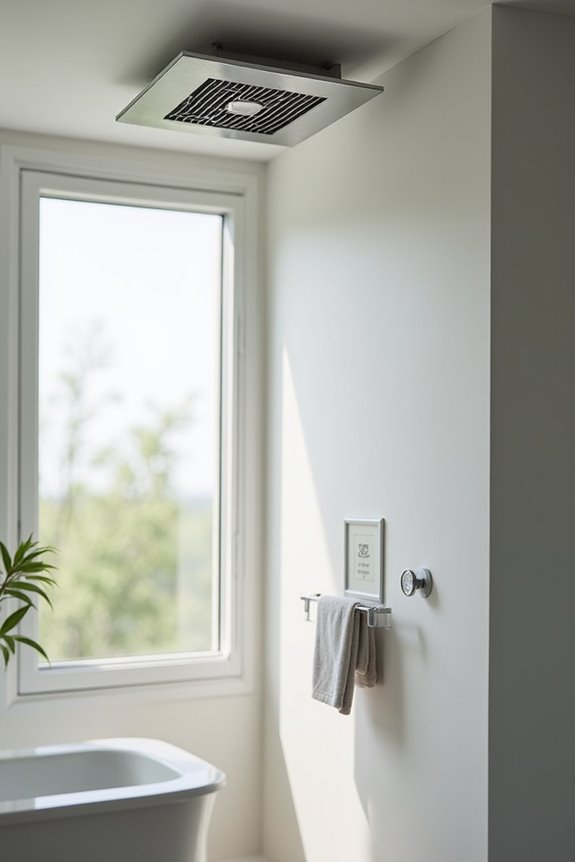
When you’re shopping for an exhaust fan, how do you know you’re actually getting what the manufacturer claims? I’ve learned that noise matters more than I’d thought. You’ll want a fan operating at 1.0 sone or quieter—anything louder disrupts your peace. That’s where HVI certification comes in. This independent label means the fan’s performance has been tested and verified, not just promised. Without it, you’re gambling on inflated claims. Beyond noise and certification, design is important. Your ventilation system needs to vent directly outside, not into your attic or crawlspace. That outdoor venting prevents moisture from accumulating where it shouldn’t. These three features—quiet operation, verified certification, and proper exterior venting—form the foundation of an effective exhaust fan.
How to Use Your Exhaust Fan Effectively
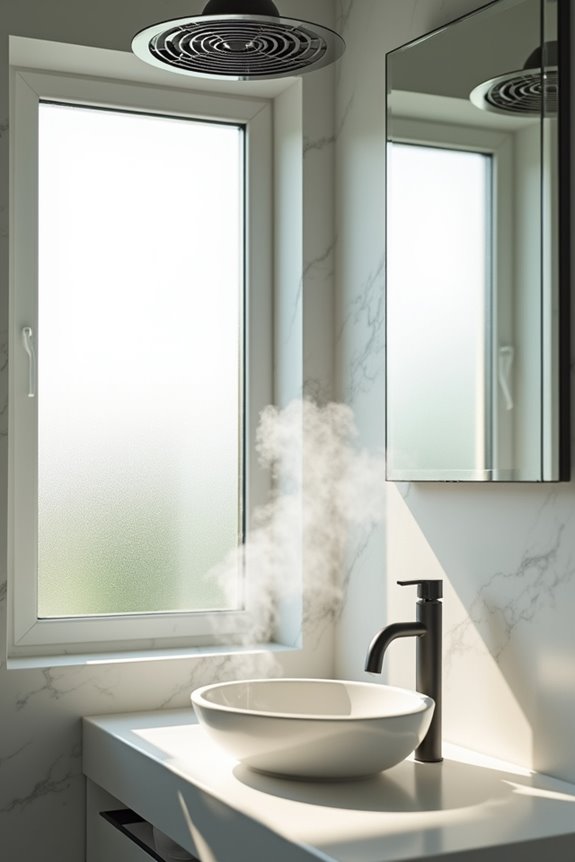
Having the right exhaust fan installed is only half the battle—you actually need to use it correctly to keep your bathroom dry and mold-free.
I’ve learned that timing and consistency are important. Here’s what actually works:
- Turn your exhaust fan on before stepping into the shower so it catches moisture right away
- Keep it running for about 20 minutes after you’re done to remove lingering humidity
- Make sure your venting duct leads outside—not into your attic or crawlspace where moisture gets trapped
- Clean the fan and vents every few months so nothing blocks the airflow
One trick I use? Leaving a small gap under my bathroom door (about 3/4 inch) to help air circulate better. These habits prevent mold and keep your bathroom feeling fresh.
Maintaining Your Fan: Monthly and Seasonal Checkups

I’ll keep my exhaust fan running smoothly by tackling three maintenance tasks: cleaning the filters and vents to prevent dust from choking airflow, checking the ductwork for blockages that might trap moisture in my bathroom, and testing the fan regularly to confirm it’s working properly. These aren’t complicated projects—I’m mostly just looking for dust buildup, debris, or any reason my fan might be struggling. When I stay on top of these checks, I avoid mold, odors, and a fan that sounds like it’s working overtime just to move stale air around.
Cleaning Filters And Vents
Your exhaust fan is basically a dust magnet, and that’s actually a good thing—it means it’s doing its job. But here’s the thing: all that trapped dust and excess moisture buildup means you’ve got maintenance to tackle.
- Clean fan blades monthly – Dust accumulation reduces airflow and makes your fan work harder than necessary
- Check exterior vents seasonally – Debris blocks exhaust from reaching outdoors, trapping excess moisture inside
- Wipe duct surfaces – This minimizes annoying noises and keeps performance running smoothly
- Inspect power connections monthly – You’ll catch problems before they become safety hazards
I know maintenance sounds tedious, but spending fifteen minutes monthly keeps your bathroom dry and your fan efficient. When you’re part of this routine, you’re protecting your home from humidity damage. That’s the kind of small effort that pays real dividends.
Checking Ductwork For Blockages
Where does all that moisture-laden air actually go after your fan sucks it up? It travels through your ductwork to the outside. Blockages happen regularly.
I’ve found lint, leaves, and debris clogging ducts more often than I’d like to admit. When your bathroom exhaust fan’s ducts get blocked, moisture backs up into your bathroom instead of escaping outside. That’s when problems start.
Check your ducts for kinks or crushed sections that choke airflow. Look at duct connections for condensation or mold—red flags indicating leaks or blockages. Don’t forget the exterior vent termination either. Snow, lint buildup, and debris pile up there, preventing proper exhaust.
If you spot reduced airflow or strange noises, call a professional. Some ductwork damage isn’t safe to tackle yourself.
Testing Fan Performance Regularly
Once you’ve confirmed your ductwork is clear, the real work begins—making sure your fan actually does what it’s supposed to do. I’ll be honest: most of us ignore our fans until they stop working entirely. That’s where regular testing comes in.
Here’s what I check:
- Monthly runs – I turn on the fan and listen for smooth operation and unusual noises
- Airflow verification – I aim for at least 50 CFM in small bathrooms, more for larger spaces
- Seasonal exterior checks – I keep the vent opening debris-free and verify humidity drops after showers
- Quarterly cleaning – I wipe the grill and fan to prevent dust from choking ventilation performance
When your fan underperforms, that’s your signal to call an HVAC contractor. They’ll inspect for duct leaks and backdraft damper issues. Catching problems early prevents mold issues down the line.
Does Your Bathroom Have No Fan? Temporary Fixes and Long-Term Solutions
What happens when you step out of a steamy shower and realize your bathroom has no exhaust fan? Don’t panic. You’ve got options.
First, try the basics. Open a window to let excess moisture escape—it’s not perfect, but it helps. Crack your bathroom door open afterward too. These simple moves improve air flow and reduce humidity buildup.
For something stronger, consider a portable dehumidifier. It’ll pull moisture from the air, though it won’t match a real fan’s power.
Here’s the truth: temporary fixes work short-term. They won’t solve your moisture problem forever. You’ll eventually want a proper exhaust fan installed—aim for at least 50 CFM for small bathrooms. Hire a professional to install it correctly, verify it’s vented outside properly, and confirm it meets local codes. Your bathroom (and your walls) will benefit from this investment.
Should You DIY or Hire a Pro?
So, you’ve decided your bathroom needs an exhaust fan—now comes the harder question: should you install it yourself or call in a professional?
DIY installation tempts many of us, but proper ventilation requires more than just hanging a fan. Here’s what you’re taking on:
DIY installation tempts many of us, but proper ventilation requires more than just hanging a fan.
- Understanding local building codes and electrical safety requirements
- Calculating correct CFM sizing for your bathroom’s square footage
- Running ductwork properly to the outdoors without moisture leaks
- Maintaining airtight connections to prevent mold in attics or crawlspaces
Hiring a pro handles these headaches. They’ll verify compliance, place exterior vents correctly, and guarantee your fan actually works. For complex situations—new construction, ceiling constraints, or high ceilings—professionals deliver peace of mind and optimal performance. Sometimes calling someone beats learning the hard way.
Ready to Improve Your Bathroom Ventilation?

Installing an exhaust fan isn’t glamorous, but it’s one of those quiet upgrades that actually improves your bathroom. I’ve found that proper ventilation keeps moisture from turning your bathroom into a mold factory. You’re making a smart choice by tackling this now.
| Your Ventilation Goal | Why It Matters |
|---|---|
| Remove humid air | Prevents mold growth |
| Size fan correctly | Handles your bathroom’s moisture load |
| Vent outside | Stops moisture from hiding in attics |
| Place near shower | Captures humidity at the source |
| Maintain regularly | Keeps performance strong long-term |
Whether you’re hiring a pro or going DIY, you’re investing in fresher air and healthier walls. Your bathroom—and your lungs—will benefit from this upgrade.